
Prosidio is being built on AI infrastructure, not ad hoc AI usage.
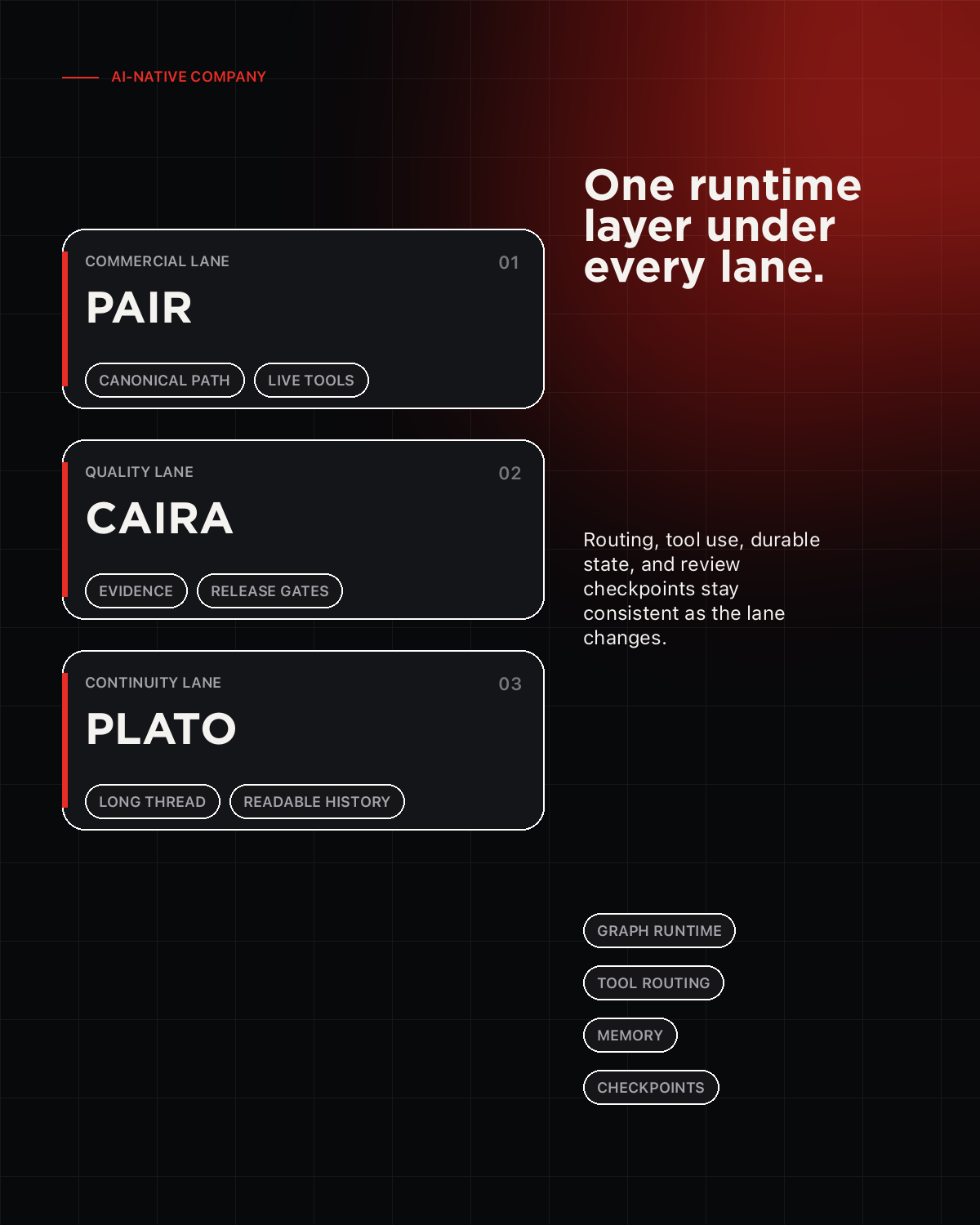
PAIR, CAIRA, and PLATO are lane-specific AI agents running on shared agentic infrastructure: graph-based orchestration, live tools, durable state, and human checkpoints. That is how Prosidio operates at a different level of throughput and efficiency.
Operating thesis
This is what an AI-native operating company looks like in practice.
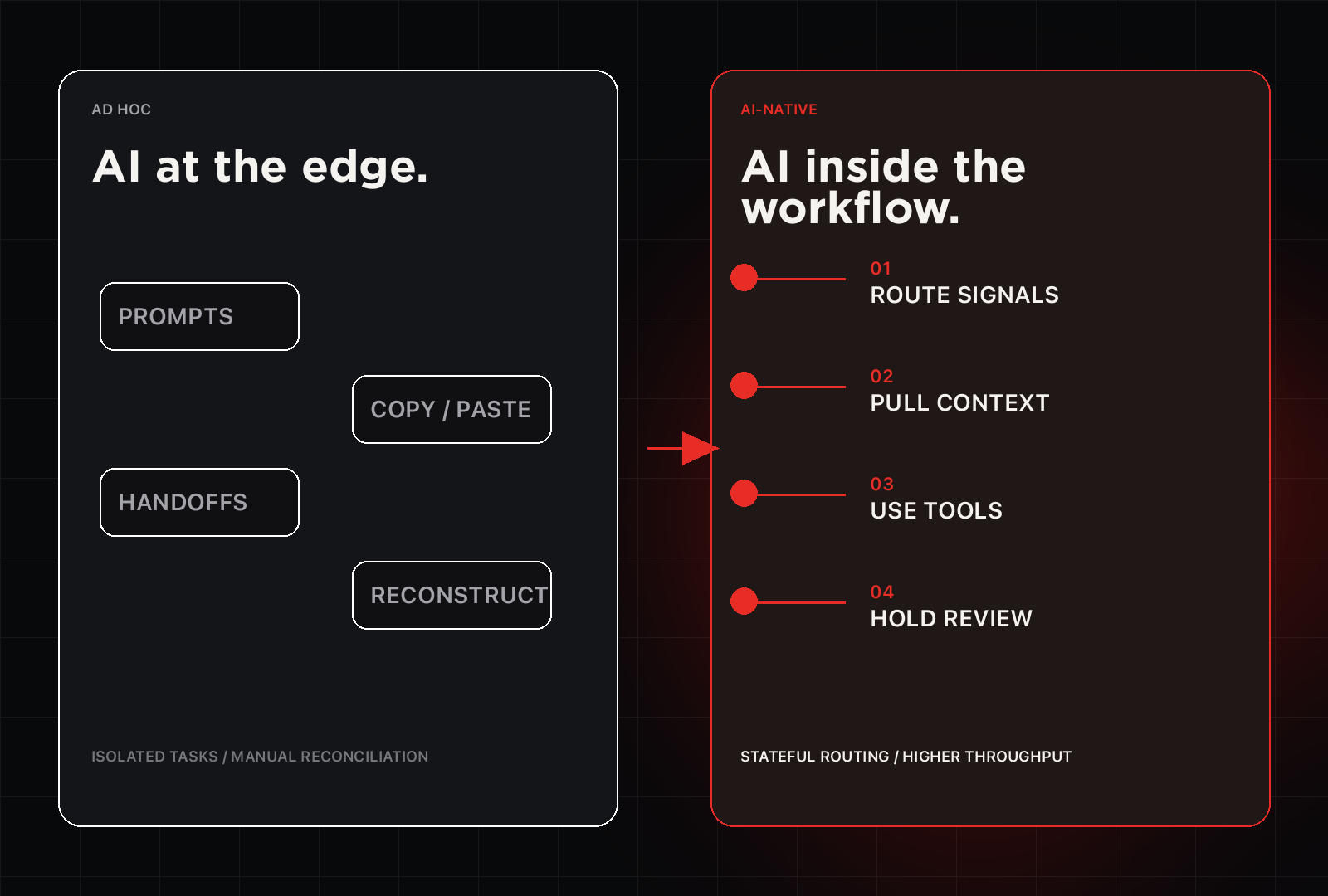
Prosidio belongs to the next generation of companies being built around agentic infrastructure rather than sprinkling AI across isolated tasks. The systems are not sitting at the edge of the company. They are in the middle of the work.
Prosidio AI Rep (PAIR), Compliant AI for Regulatory Affairs (CAIRA), and Prosidio's Longitudinal Accounting and Tracking Organizer (PLATO) each own a broad operational lane. Together they increase signal coverage, compress cycle time, and reduce the amount of work that falls back into manual reconstruction.
The payoff is not novelty. It is another scale of throughput: more commercial follow-through, faster governed case assembly, and cleaner operational continuity without loosening accountability.
Operating sequence
Signals do not stop at the inbox. They move through one operating sequence: lane-specific routing, live context, action inside the workflow, and human checkpoints where the consequence is real.
Signals enter structured lanes instead of being trapped in inboxes and handoffs.
The right agent picks up the work with the right scope, tools, and boundaries.
Live context is pulled, tools are called, and the next move is shaped inside the workflow.
Humans stay at the consequential decision points while throughput stays high.
Commercial AI agent system
Prosidio AI Rep (PAIR) is Prosidio's commercial AI agent. It interprets inbound work, calls into live business tools, researches when needed, and prepares the next move inside the commercial workflow.
- 01Broad remit across chat, email, and trusted routed signals.
- 02Stateful tool use over live deal context instead of canned assistant replies.
- 03Higher throughput because inbound work stays in motion while the rep keeps control.
Chat, email, and routed workflow events hit the same commercial agent path.
Deal state, history, and business context are pulled before the response takes shape.
The agent classifies, researches, drafts, and keeps the rep in control.
Quality AI agent system
Compliant AI for Regulatory Affairs (CAIRA) is Prosidio's QMS AI agent. It ingests quality signals, assembles evidence, routes governed casework, and stages review-ready artifacts behind hard release gates.
- 01Broad remit from complaint intake through evidence assembly and draft generation.
- 02Procedure-aware case handling with durable state and human checkpoints.
- 03Higher throughput because review-ready artifacts arrive faster without weakening sign-off discipline.
Complaint signals and documents are preserved as case evidence.
Evidence, OCR, and procedure-aware context are attached to one governed path.
Drafts move fast, but the published record still waits for human approval.
Operational continuity AI agent system
Prosidio's Longitudinal Accounting and Tracking Organizer (PLATO) is Prosidio's operational continuity AI agent. It keeps orders, serial state, service events, and operator context attached to one durable thread that the team can act from directly.
- 01Broad remit across order origin, receiving, service state, and operational memory.
- 02Durable longitudinal state instead of disconnected status snapshots.
- 03Higher throughput because teams act from live history instead of reconstructing the past.
Orders and first operational touchpoints establish the record.
Serial, inventory, and service events keep extending the same thread.
Teams act from durable history instead of rebuilding the past.
Shared infrastructure
One substrate. Three lane-specific agents.
Operating confidence
AI-native companies do not use AI around the edges. They run through it.
What a customer, partner, or sophisticated observer notices is a team working at a different pace, with cleaner context and less operational drag. The systems underneath that performance are already in place.